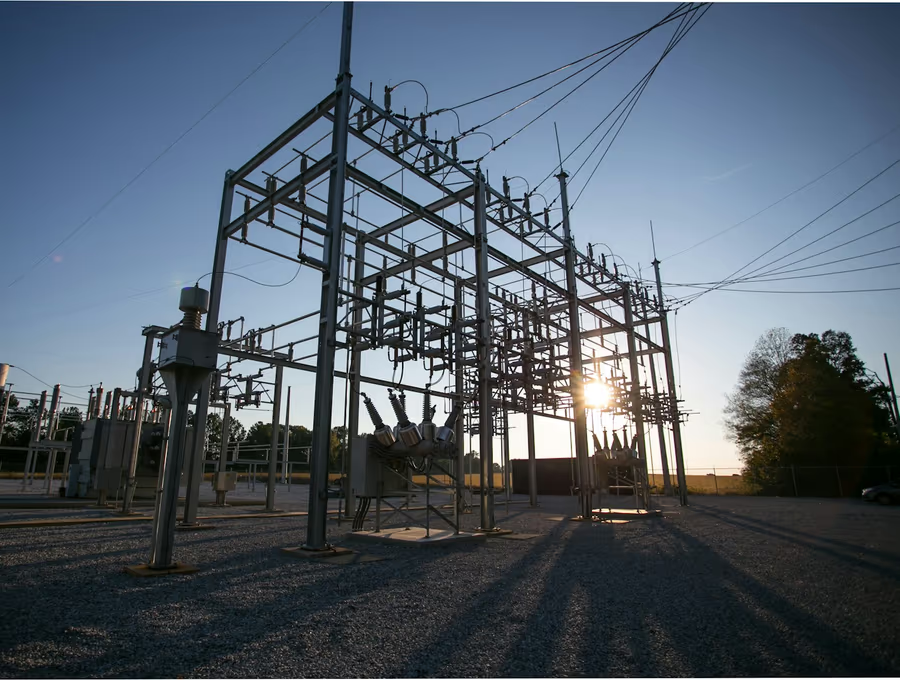
Grid operators and hyperscale data center buyers are two of the most demanding audiences for verified environmental data right now, and electrical equipment manufacturers sit directly in their supply chain. Switchgear, transformers, cabling, and data center hardware all face a documentation bar that general manufacturing hasn’t had to clear until recently — and an EPD is how that bar gets met.
What’s Different About an Electrical Equipment EPD
Electrical and digital infrastructure equipment typically follows PEP ecopassport Product Category Rules rather than the EN 15804 rules built for structural construction products, though both trace back to the same ISO 14025 foundation. The impact profile is dominated by conductor metals — copper and aluminum — plus, for switchgear specifically, the insulating gas used inside the unit.
Key Materials Typically Covered in an Electrical Equipment EPD
- Copper and aluminum conductors — usually the largest single contributor to embodied impact
- Steel or aluminum enclosures — housing and structural components
- Insulating gas — SF6 or its lower-GWP alternatives, specific to switchgear
- Semiconductors and electronic components — relevant for smart meters, controls, and power electronics
- Specialized plastics and polymer insulation — cabling and component-level materials
Key Standards and PCRs for Electrical Equipment EPDs
Electrical and electronic equipment has its own dedicated program, separate from the construction-products framework: PEP ecopassport, built on EN 50693 rather than EN 15804. It defines Product Category Rules for broad equipment families and more granular Product Specific Rules (PSRs) for individual equipment types, including functional units like “1 kWh delivered” or “one rack-mount server operated for five years” — a different approach than the physical-unit functional units used in construction PCRs. Equipment that gets assessed as part of a whole-building LCA (a busway or backup power system specified into a LEED project, for example) may also need to reference EN 15804 or ISO 21930 alongside its PEP declaration.
Top EPD Program Operators for Electrical Equipment
- PEP ecopassport (the P.E.P. Association) — the dedicated Program Operator for electrical, electronic, and HVAC-R equipment, and the default choice for most switchgear, transformer, and data center hardware manufacturers
- UL Solutions and International EPD System (EPD International) — relevant when equipment is being declared under a general construction-products PCR instead, typically because it’s being specified into a building-level LEED or BREEAM calculation
Most electrical equipment manufacturers will work primarily with PEP ecopassport, and only need a second operator if a specific building-integrated product also needs a construction-sector declaration.
Sample EPDs for Electrical Equipment
For building-integrated electrical products declared under a construction-sector PCR, EPD Global’s registry for electronic and electrical components, cables, and products publishes real, verified examples. For equipment declared through PEP ecopassport specifically, the PEP ecopassport program’s own public database is the primary source to review comparable published declarations.
Why the Electrical Sector Needs EPDs Now
SF6 phasedown compliance needs documented proof
Sulfur hexafluoride, long used as an insulating gas in switchgear, is thousands of times more potent than CO2 and is being phased down under tightening global regulation. An EPD gives utility and grid customers a verified, quantified record of a product’s alternative-gas footprint rather than a supplier’s word for it.
Data centers are driving Scope 3 accounting down the supply chain
Colocation providers and hyperscale operators are under real pressure to hit corporate net-zero commitments, and vendor equipment is a direct line item in their Scope 3 emissions. An EPD gives these buyers exact figures instead of industry-average estimates, and it’s becoming a standard part of vendor screening for busways, backup power systems, and cooling infrastructure.
Green building and infrastructure procurement
LEED and BREEAM both reward EPD-backed material specifications, and utility and municipal grid operators increasingly write verified environmental data into infrastructure tenders as a baseline requirement rather than a bonus.
Managing EPDs Across Configurable Product Lines
Electrical equipment ranges from small breakers to modular substations, often with highly customizable configurations. AI-powered EPD software can model that configurability directly — mapping alloys, semiconductors, and plastics to current datasets — so engineering teams can generate compliance documentation as fast as they iterate on product design.
How to Get Started on Your Electrical Equipment EPD
- Find the right PSR within PEP ecopassport. Product Specific Rules exist for individual equipment families — the more precisely you match your product to one, the less ambiguity later in verification.
- Define your functional unit. Whether that’s energy delivered, a service-life-based unit, or a physical unit, depending on what the PSR specifies.
- Build your bill of materials. Conductor metals, enclosure materials, insulating gas type, and electronic components, plus an operational-energy or loss profile if your PSR requires it.
- Model and verify through PEP ecopassport. Or through a construction-sector operator if the product is being declared for building-level specification instead.
- Publish, and revisit sooner than five years if regulation moves. SF6 phasedown timelines and refrigerant-adjacent rules change faster than most construction regulation, so treat the five-year validity window as a ceiling, not a target.
Optimize Your Electrical Product Sustainability with CarbonBright
CarbonBright’s EPD platform is built to handle the multi-component complexity of electrical and digital infrastructure manufacturing. Generate verified reports at scale and give grid and data center customers the documented data they’re already asking for. Contact CarbonBright today.