This guide is based on nearly four years of supporting manufacturers with AI-powered life cycle assessments (LCAs) and Environmental Product Declarations (EPDs) across construction, furniture, industrial applications, electronics, chemicals and healthcare. Over that time, CarbonBright’s AI-powered platform has completed multiple independent third-party verifications, and EPDs built on it have been independently verified and published (see a published example). What follows is what that work has taught us about where AI improves LCA quality, where it should stay out of the way, and how to tell the difference when you evaluate a platform.
Key takeaways
- AI can make LCAs and EPDs more reliable, not just faster, when it handles the right tasks: reading documents, suggesting data matches and catching errors. The math stays in tested software, and the platform user makes the decisions.
- Most of the quality comes from groundwork done before your product is assessed: expert-reviewed data for your industry, your product category’s rules built in as automatic checks, and targeted training for the people who use the platform.
- Volume can work in your favor. Every product you assess gives the system more comparisons for catching unusual results.
- AI-powered EPDs can be independently verified. Look for platforms where every number traces back to its source. That is what makes results defensible to customers and verifiers.
Can you trust LCAs and EPDs built with AI?
If you manage sustainability for a manufacturer, you know the squeeze. Customers, architects and procurement teams want product carbon footprints and EPDs, often for hundreds of products. The experts who produce them are expensive and booked up.
AI promises to close that gap, and it raises a fair worry: will numbers produced with AI hold up when a verifier or a customer looks closely? AI has earned some of its bad reputation. Used carelessly, it produces plausible-looking numbers nobody can defend.
Our experience points the other way: used correctly, AI improves the quality of LCAs and EPDs, especially at scale. The rest of this post shows, in plain terms, what “AI done right” looks like at each step.
Why LCA quality suffers as volume grows
A good LCA needs two kinds of expertise that rarely come in one person, and demand is growing faster than the supply of people who have both.
- LCA expertise: the methodology, the ISO standards, and the Product Category Rules (PCRs), the rulebooks that define how products in a category must be assessed for an EPD.
- Industry expertise: how your products are actually made, which materials and processes matter, and where product data typically goes wrong. Modeling a chemical formulation takes different knowledge than modeling an office chair.
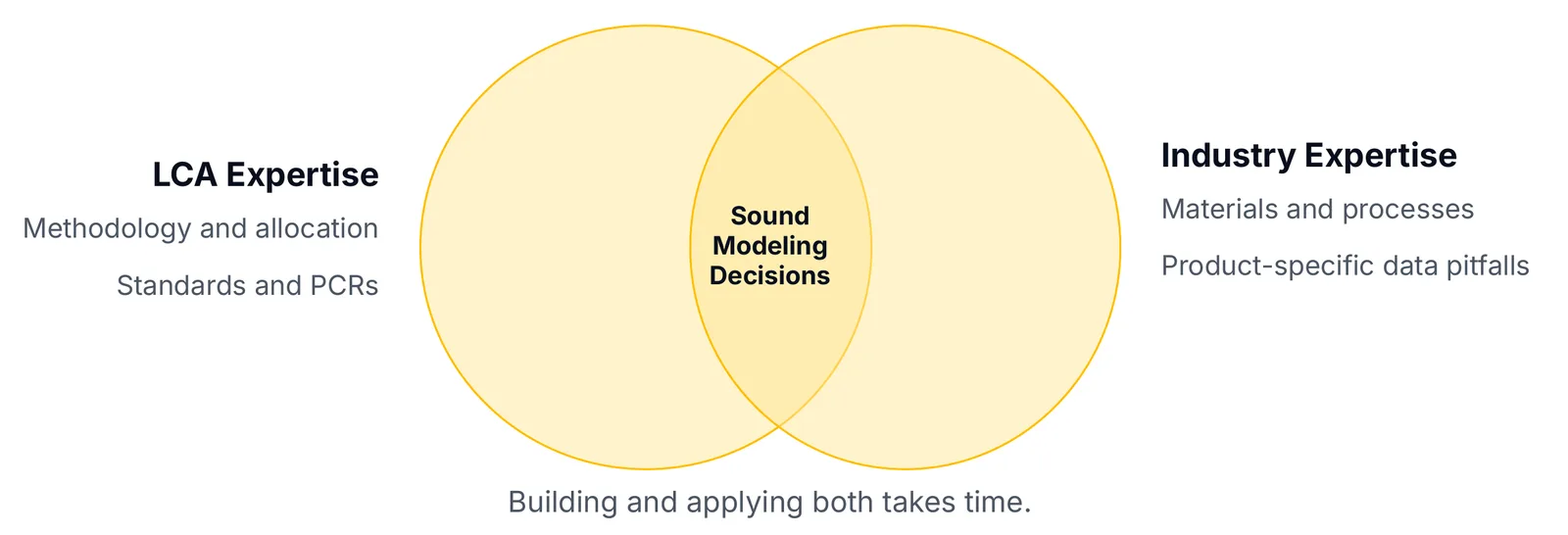
Each takes years to build. Meanwhile, EPD Central counts more than 14,800 EPDs published worldwide as of August 2026, up from 5,300 in 2020, and many manufacturers have thousands of products.
Most manufacturers already have the industry expertise in house. A well-designed platform supplies the LCA side, built in by LCA experts and backed by targeted training, so the people using it do not need to become LCA specialists.
The cost-quality trade-off
With a traditional, mostly manual approach, three things happen as volume grows:
- Holding quality steady means costs keep climbing. Every LCA needs the same expert modeling and review time, plus its own verification.
- Budgets are usually fixed, so quality gets squeezed. Less time per product means less time to investigate odd data and catch mistakes.
- AI and automation change the economics. There is an upfront investment in expert knowledge, rules and checks. After that, each additional product costs less, quality holds, and a growing portfolio can even improve quality.

So the question to ask about any approach is not only “how fast?” but “how does quality hold up at our volume?” The rest of this post explains how.
AI done right: the right tool for each step
A trustworthy AI-powered LCA platform does not hand every task to an AI model. It uses AI where AI is the best tool, keeps all calculations in tested, version-controlled software, and leaves decisions to the platform user.
Here is how that works on the CarbonBright platform across the five stages of an assessment:
| Stage | What AI does | What the software does (same inputs, same results) | What the platform user does |
|---|---|---|---|
| 1. Collecting data | Pulls key details from your documents, such as spec sheets and supplier reports | Reads files and converts units | Confirms what is in scope |
| 2. Matching data | Suggests a match only when a material is not already mapped | Maps known materials using approved rules | Accepts or changes the match |
| 3. Calculating impacts | Not involved | Runs every impact calculation | No action needed |
| 4. Quality checks | Explains any issues the checks raise | Runs rule-based checks, including your PCR’s rules | Resolves each flagged issue |
| 5. Reporting | Drafts the narrative, with citations | Generates every number and table | Approves before release |
This is the practical answer to the “black box” worry. Every number comes from calculation logic that can be inspected and reproduced. Every AI suggestion comes with its reasoning, the platform user accepts or overrides it, and that decision is recorded. When a customer or verifier asks where a number came from, there is an answer.
The biggest gains happen before your product is assessed
Most of the quality improvement comes from AI used to prepare expert knowledge in advance, not from AI improvising while your team enters data.
Think of an Olympic sprinter: the race takes seconds, but it rests on years of training. AI-powered LCA works the same way, with a preparation phase and a run-time phase.
Before an assessment (preparation). Built once with expert review, then reused for every product in the category, with no AI model called while your product is assessed. AI helps our LCA experts:
- Build and review a curated library of background data for your industry
- Read the PCR for your product category and turn its requirements into automatic checks
- Create training tailored to your products and PCR for the people who use the platform
- Draft guidance that experts review and test before it is used
At CarbonBright, our team does this heavy lifting as the platform provider, so your team does not have to.
During an assessment (run time). Applied to your specific product. Only selected tasks call an AI model, where it helps:
- Read your documents. One customer uploads a 35-page quality report in which only one page matters for the carbon footprint; AI finds and extracts it.
- Suggest data matches for materials described in unfamiliar terms
- Flag data that looks inconsistent
- Draft explanations and answers to reviewer questions
Everything else, including standard calculations, approved data matches and rule-based checks, runs in ordinary, tested software.
How AI improves quality at each step
Errors can enter an LCA at every step: choosing data, collecting it, building the model and reviewing results. Here is what AI and automation catch at each one, with examples from our platform.
1. Choosing the right background data
Every LCA relies on background datasets: industry-average environmental data for materials and processes, usually from databases such as ecoinvent. Choosing the right one is one of hundreds of judgment calls in a single assessment.
Expert review comes first, AI second. For each industry we work in, such as furniture, our LCA experts build a curated set of background datasets and pre-check how materials map to them. AI speeds up building that library, and experts review it before it is reused.
When your product is assessed:
- The curated library covers most materials automatically.
- AI suggests a match, with its reasoning, when something is described differently.
- The platform user confirms the match against what they know about the product, and any assumptions are recorded.
2. A matching name can hide a costly mistake
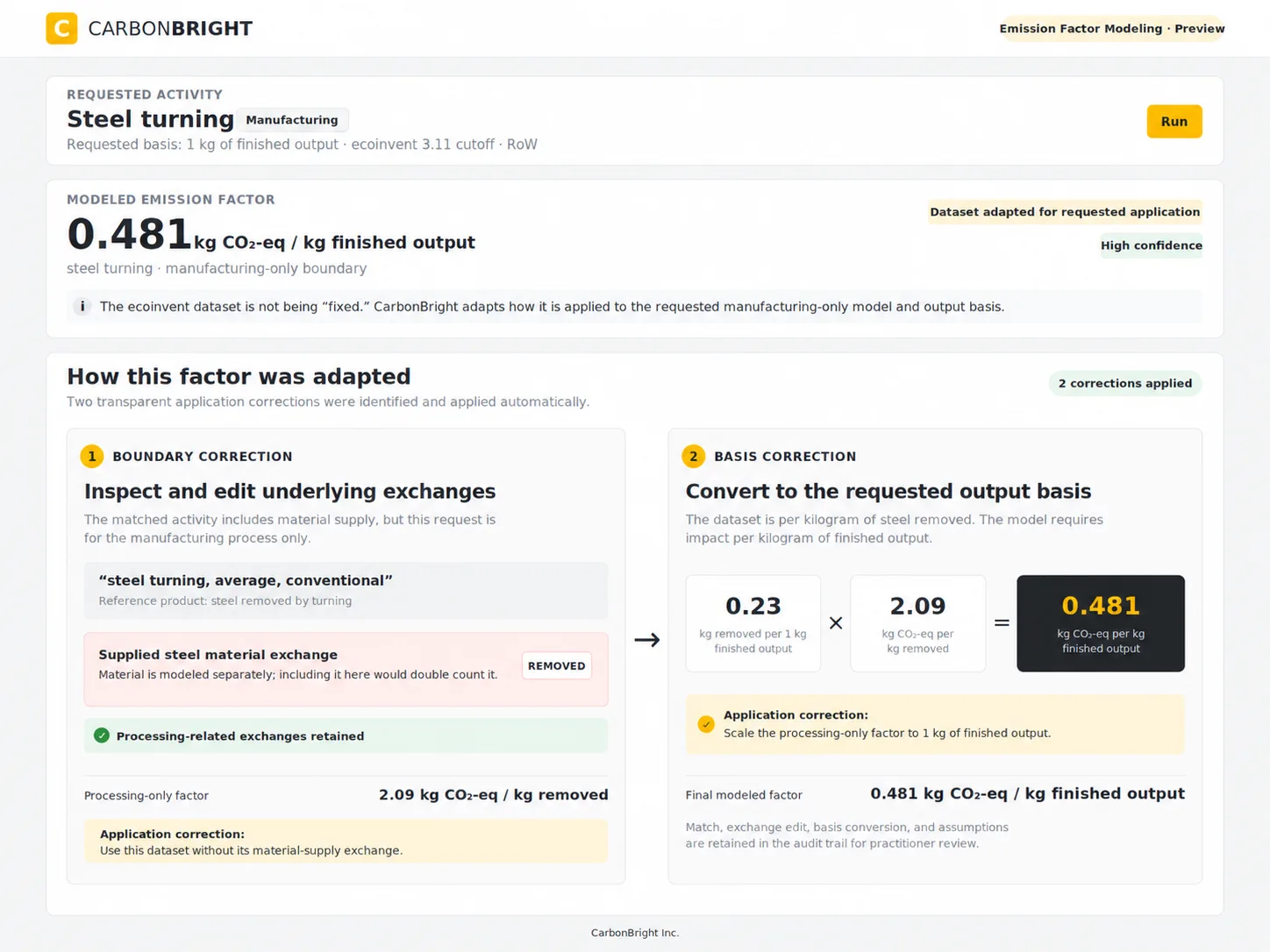
A dataset whose name looks right can still be wrong for your product. Take a machined steel part made partly by steel turning (cutting steel on a lathe). A search of ecoinvent returns a dataset whose name is a perfect match:
| Manufacturing step | Candidate background dataset |
|---|---|
| Steel turning | steel turning | RoW | cutoff (ecoinvent 3.11) |
Reading the fine print means asking three questions of any dataset: What does it include? What exactly does one unit of it measure? Does it overlap with anything your model already counts? Here, the answers reveal two problems:
- It measures the wrong thing. The dataset describes a kilogram of steel removed as chips, not a kilogram of steel part processed. Its documentation suggests an average factor of 0.23 to convert one to the other. Skipping that correction overstates the turning step about four times over.
- It counts the steel twice. The dataset already includes the steel itself, not just the machining. If your bill of materials already lists the steel, as it normally does, using this dataset adds that steel a second time.
Both mistakes push the footprint too high, and both are easy to miss when an analyst is rushed. AI can read the dataset’s full description and inputs, flag the mismatch and explain it. Our LCA experts review the correction, and the calculation software computes the result.
3. Preventing bad data at the source
Garbage in, garbage out. The people using the platform are usually not LCA specialists. They work in sustainability, engineering or operations and know the products well. What they need is to know exactly what to collect for their product category.
Rules also differ by PCR and EPD program. Some restrict how purchased green energy certificates can be counted, for example. Your team needs to know that before collecting data, not after a verifier rejects it.
AI makes tailored training affordable. We feed in the applicable rules, AI drafts training specific to your product category and PCR, our LCA experts review it, and platform users complete a short certification on the critical points.

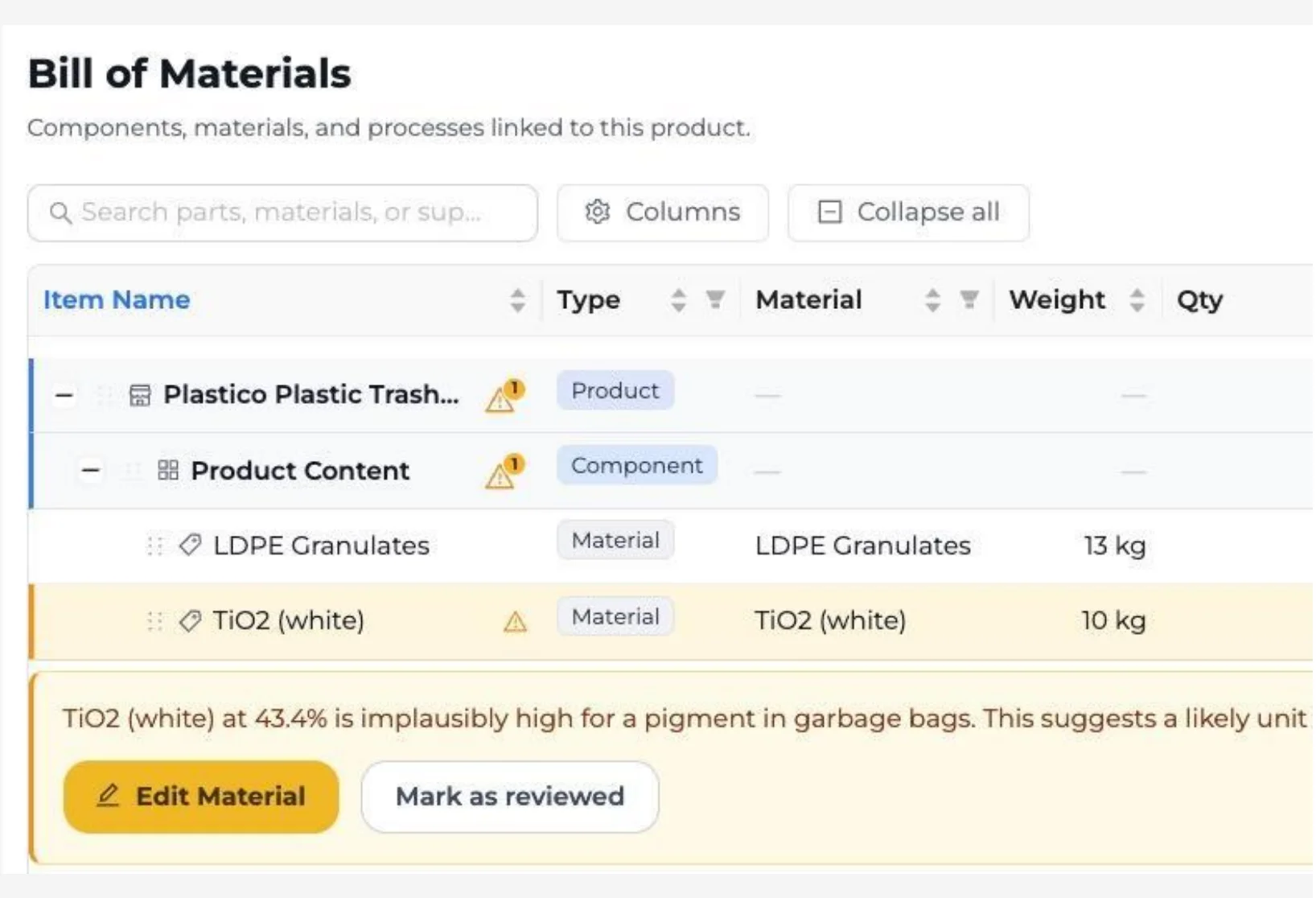
4. Catching unit errors and implausible values
Everyone makes entry mistakes, like picking grams instead of kilograms. Rule-based checks catch obvious unit problems. AI review goes further and flags quantities that look implausible for this specific product.
Each flag shows the value entered and why it looks wrong, and asks the user to check the source before anything changes.
5. Spotting components missing from the bill of materials
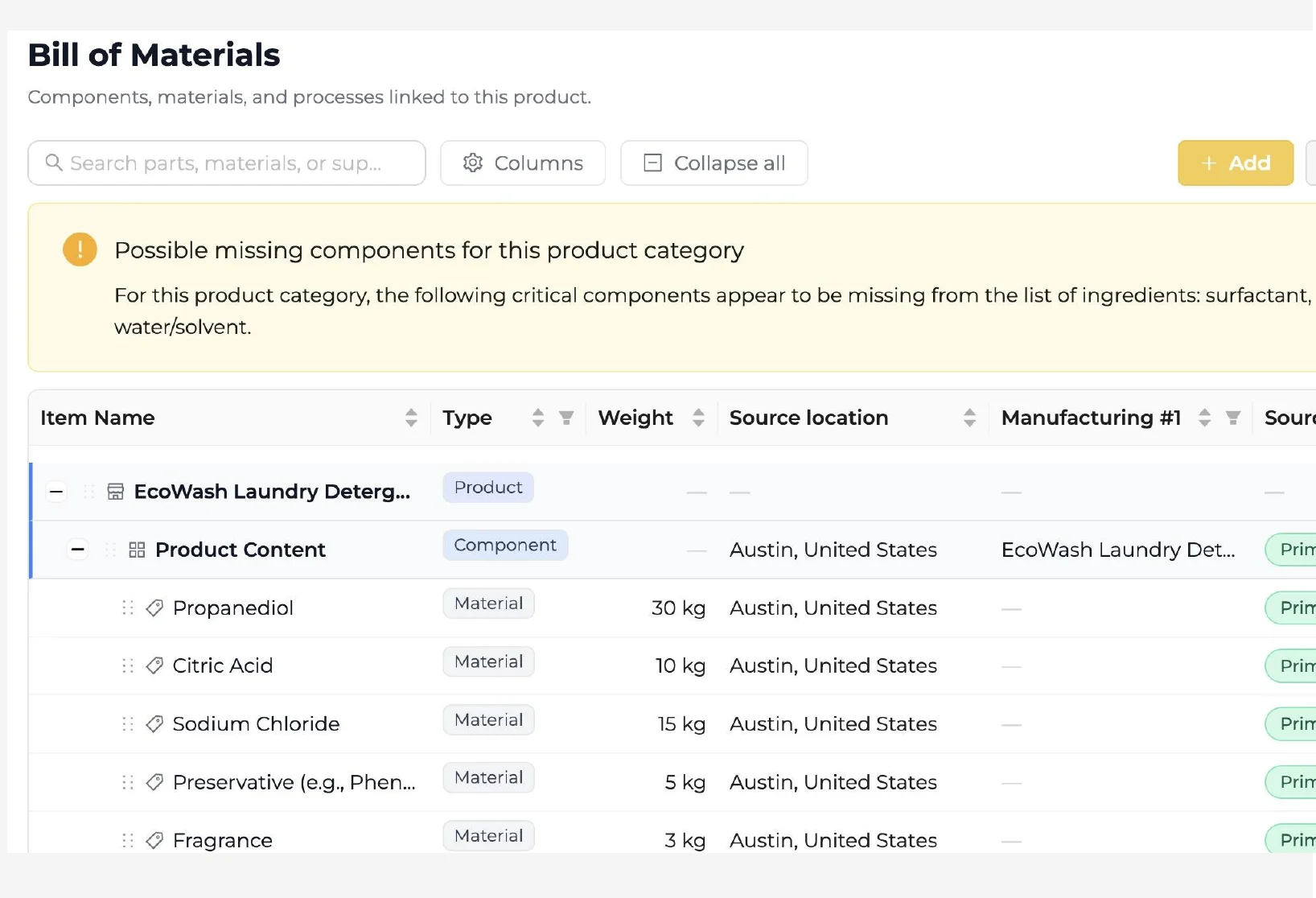
Incomplete product data is one of the most common LCA problems. If an office chair’s bill of materials has no casters, something is probably missing. The platform knows which components a product like this should have, compares that with the bill of materials, and asks a follow-up question. In the example below, a laundry detergent’s ingredient list has no surfactant or water, both of which a detergent would normally contain.
It asks rather than assumes, because the missing item may sit inside an assembly or be listed under a different name.
6. Automatic consistency checks on the model (no AI involved)
Once the model is built, tested software runs the same checks on every assessment:
- Complete life cycle: every stage is included, each process sits in the right stage, and nothing is counted twice.
- Mass balance: what goes in equals what comes out (product, scrap and losses), overall and between steps.
- End of life: the waste transported and treated matches the waste generated.
- Reports: quantities in the report match the model.
AI may help design or explain these checks, but it does not run them.
7. Using your portfolio to catch outliers
This is where scale becomes an advantage. Once many of your products are assessed, each new result can be compared with similar products.
- The platform compares the result with comparable products and earlier assessments.
- It flags unusual results, such as one life cycle stage being far larger than usual.
- It investigates the likely cause and flags it for review.
Instead of combing through the whole bill of materials, the reviewer sees the driver directly: for example, a part with 0% recycled content where similar products use recycled material. An outlier can still be correct, and comparisons only work when products are assessed the same way under the same rules.
Can AI-powered EPDs be third-party verified?
Yes. An EPD built with AI assistance goes through the same independent verification as any other EPD, and the verifier decides whether it conforms. EPDs built on CarbonBright have passed verification (see a published example), and we work with smartEPD, EPD Global and SCS Global Services. What AI changes is how quickly evidence comes together and how much routine checking happens before the verifier sees the file.
What a verifier reviews
- Requirements: a checklist built from the standards, the EPD program’s rules and the PCR
- Inputs: your source data, assumptions and modeling choices
- Model: the calculations, results and claims
- Resolution: evidence and responses to the verifier’s questions
Each EPD takes real verifier time. If you need EPDs for many products, verification becomes a bottleneck too, so it has to scale along with modeling.
Pre-verified tools: how verification scales today
A pre-verified tool has its setup verified once, so each later EPD needs a lighter review:
- The verifier reviews the tool’s defined scope, background data and calculation logic.
- Each new product reuses those approved methods.
- Later reviews focus on what is specific to each product, often spot checks on inputs.
The catch: the initial tool verification still takes weeks to months of expert work, and changes to the verified setup go through controlled review. What remains to check for each EPD depends on the program operator’s rules.
Where AI speeds up verification
On our side, AI can pre-fill the verifier’s checklist and link each answer to its supporting evidence. On the verifier’s side, AI-assisted checks can help raise questions faster.
We are developing the next step with our partner SCS Global Services: a closed feedback loop between the platform and the verifier.
- The verifier runs AI-assisted checks and raises a finding.
- The platform gathers the evidence, and AI drafts a response.
- Our LCA experts review the response and any changes to the model.
- The verifier evaluates the resolution.
- Approved lessons go back into a shared knowledge base: reviewed data mappings, tested automatic checks, and guidance and training.
Every lesson is reviewed before it takes effect, so each EPD starts from a stronger baseline than the last.
Questions to ask before choosing an AI-powered LCA or EPD platform
If you are comparing AI-powered LCA or EPD software, these questions separate transparent, verifiable platforms from black boxes. Ask every vendor, including us.
| Question | What a good answer looks like |
|---|---|
| Where exactly is AI used, and where is it not? | A clear stage-by-stage answer. Impact calculations never depend on an AI model. |
| If we run the same product twice, do we get the same result? | Yes. Calculations and data are version-controlled, so results are reproducible. |
| Can we see why a dataset was chosen, and change it? | Every match shows its reasoning. The platform user can accept or override it, and the decision is logged. |
| Is the background data curated for our industry? | The vendor’s LCA experts review data mappings for your product categories before they are reused. |
| How are our PCR and EPD program rules enforced? | Built in as automatic checks on every assessment, not left to memory. |
| How do you catch bad input data? | Checks for units, implausible values and missing components, with clear flags your team can resolve. |
| How do you check the finished model? | Automatic checks for completeness, mass balance, end of life and report consistency. |
| How do you catch outliers across our portfolio? | Comparisons with similar products, with the likely cause identified. |
| Have EPDs from your platform passed third-party verification? | Yes, with named program operators and published examples you can look up. Ask whether the tool is, or can be, pre-verified. |
| What does the verifier receive? | Evidence linked to each checklist requirement, plus a record of assumptions. |
| How do verifier findings improve the platform? | Resolved issues become reviewed data, tested checks or training, never unreviewed changes. |
| Does it use AI to make LCA results accessible across your organization? | A built-in AI copilot knows how to operate the platform on the user’s behalf. Users can work with it just as they would with a colleague who knows the LCA platform well. |
Glossary of LCA and EPD terms
| Term | Definition |
|---|---|
| Life cycle assessment (LCA) | A study of a product’s environmental impacts from raw materials through manufacturing, use and disposal |
| Environmental Product Declaration (EPD) | A standardized, independently verified report of a product’s LCA results, published through an EPD program |
| Product carbon footprint (PCF) | The greenhouse gas share of an LCA, usually reported in kg CO2e per product |
| Product Category Rules (PCR) | The rulebook for how products in a category must be assessed and reported in an EPD |
| Program operator | The organization that runs an EPD program, sets its rules and publishes verified EPDs |
| Third-party verifier | An independent expert who checks an LCA or EPD against the standards, PCR and program rules |
| Background dataset | Industry-average environmental data for a material or process, from databases such as ecoinvent |
| Bill of materials (BOM) | The list of components and materials that make up a product, with quantities |
| Pre-verified tool | LCA software whose setup and calculations were verified once, so later EPDs need a lighter review |
Human expertise, AI-powered quality at scale
AI does not improve LCA quality by replacing judgment. It improves quality through system design: expert knowledge built before the assessment, tested calculations, AI used only where interpretation is needed, and human review at every decision point. That combination lets you scale LCAs and EPDs without trading away quality, and lets each verified EPD raise the baseline for the next.
If you are evaluating AI-powered LCA or EPD software, book a walkthrough of the CarbonBright platform, or email our CTO, Thejas Nair, at thejas.nair@carbonbright.co.